My plan is to remove the head and take a look at the state of the pistons before doing anything else on the car - basically the value of classic cars has fallen massively over the last couple of years and if the engine is beyond restoration - then sadly so is the car because these engines are pretty rare. But if I CAN get the engine to move then the restoration is more about building a car that I can enjoy for many years than it being economically viable. So with that sad comment behind me, let’s crack on.
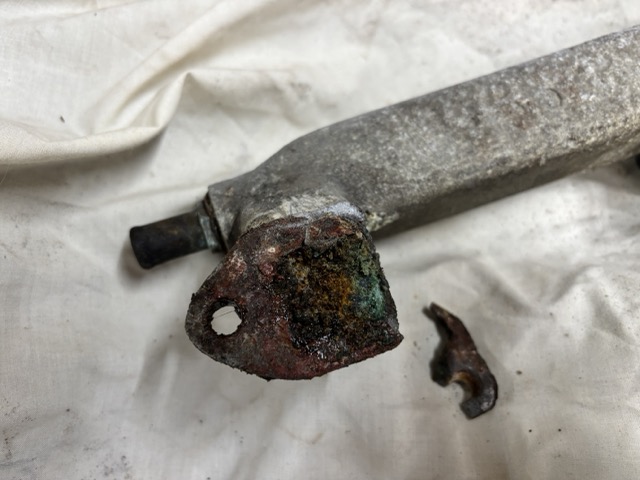
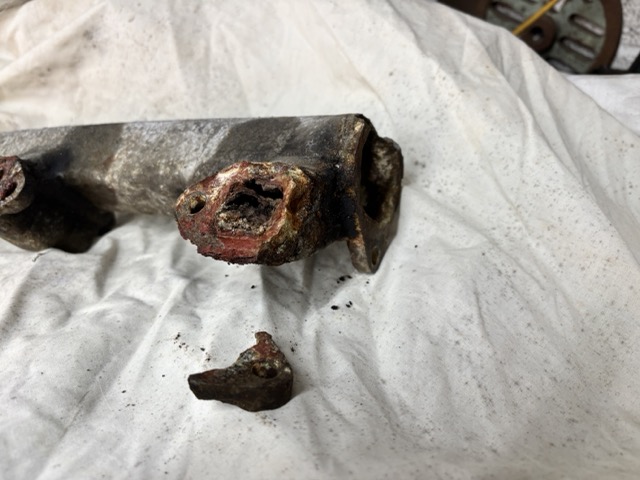
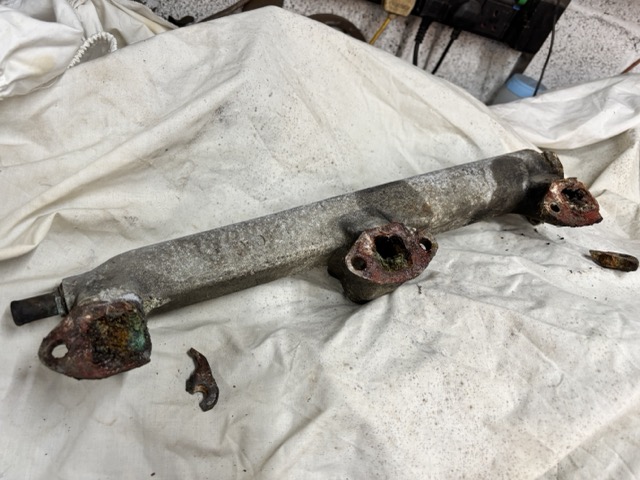
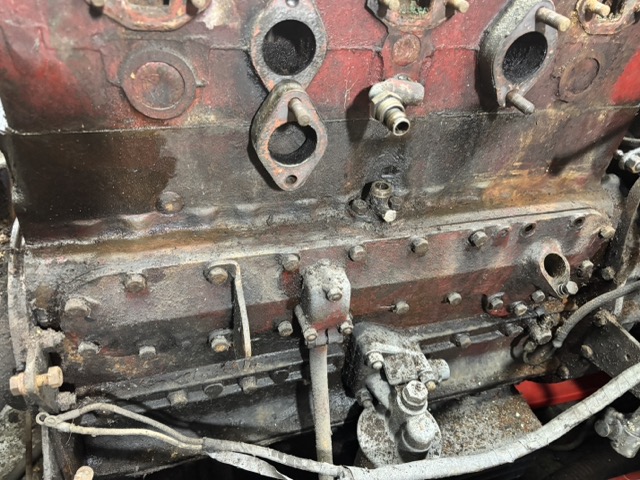
First item to be removed is an alloy casting that ports hot water from the cylinder head to the radiator - a pretty important job. Sadly as mentioned in the previous post, it has a significant crack where it bolts to the thermostat housing. Upon removal and as you can see in the picture above - the casting has other issues in that 2 of the lugs where it bolts to the cylinder head were severley corroded and they just fell apart. INSIDE the casing, the water ways were gummed up with corroded alloy. I have seen this before - when alloy encounters extended periods of moisture in the air - it swells and crystallizes. It is removable but that will still leave the issue of the broken mounting lugs

With the casting removed, I can get to the carburetor mounting bolts and as you can see in the picture below; there are 2 carburetors and they are bolted directly onto the cylinder head. This was a prewar design that was later superseded when people discovered that that the speed of the fuel/air mixture into the cylinders made quite a difference to the performance of the engine and so ‘inlet manifolds’ were developed. Between the 2 carburetors is actually a third carb - it is an ‘automatic enrichment device’ or AED. It’s basically an electrical choke used when the car needs to be started from cold and it automatically switches off when the engine no longer needs additional fuel to run.
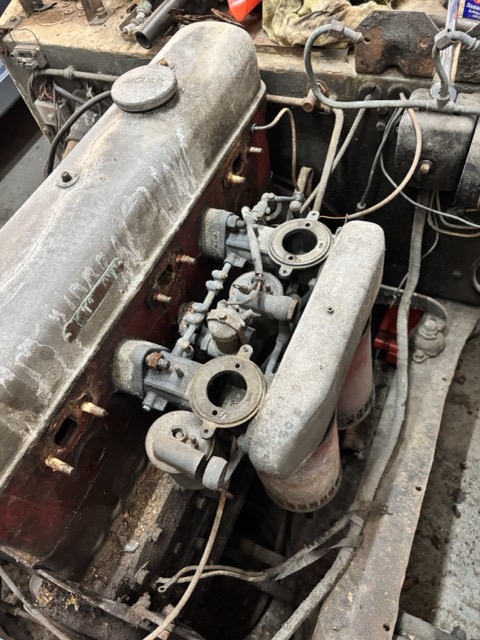
I chose to remove the entire carburettor/AED/linkiages and air filters as one unit but was disappointed to see that one of the carburetors is broken where the AED bolts on. I am guessing that something heavy landed on this area when the car was in storage but the damage could not be seen whilst they were in place. Luckily, the carburetor is replaceable and would have been rebuilt anyway but this is another item on the ‘Woe list’.

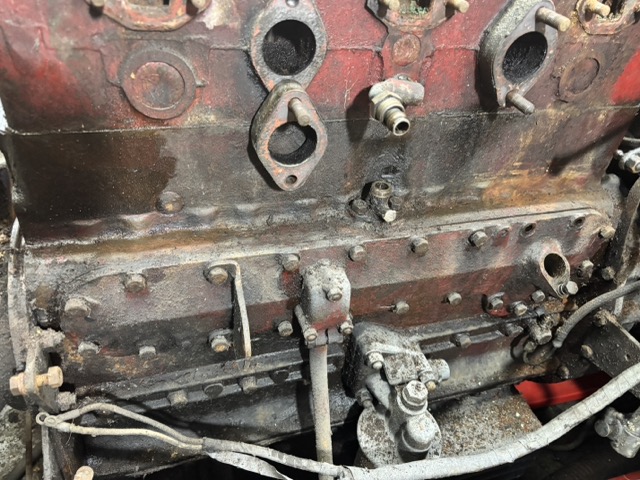
With the carburetors removed that side of the engine block now looks like this:
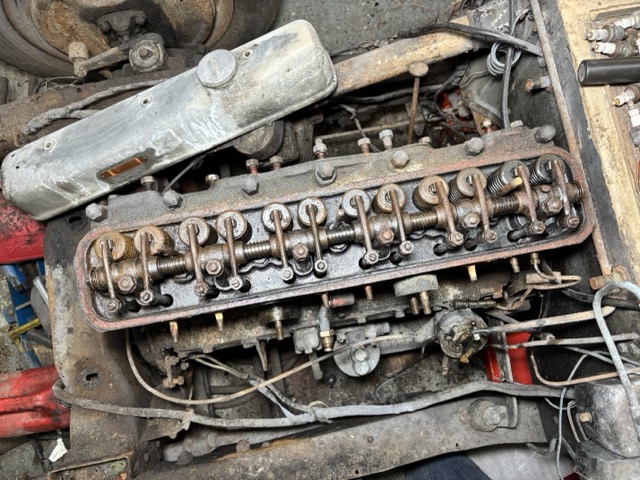
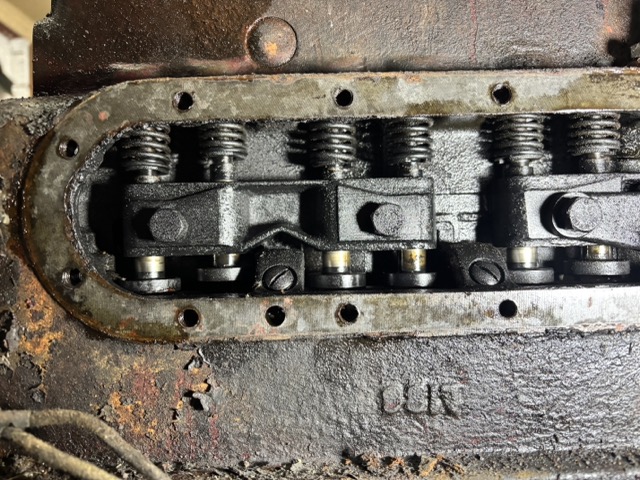
I thought this would be enough of a strip down to enable me to unbolt the cylinder head and the picture below shows the shaft that pushes down on the valves to let fuel in / exhaust gasses out. This is called the ‘rocker shaft’. The valves are above the pistons which makes this style of engine an OHV - ‘Over Head Valve’. Inside the depths of the engine is a camshaft which has one eccentric lobe per valve. As that shaft rotates the lobe pushes up a rod (yep called a push rod) which in turn lifts one side of the rocker which in moving pushes the associated valve DOWN. Strong springs return the valve to its resting place when the lobe of the camshaft is rotated back to zero lift. Pretty simple mechanics really, Fun to rebuild because it *IS* so basic. No electronics or computers needed here.
 removed the rocker shaft and put it to one side for cleaning at a later date. It is here that my experience told me that the push rods should simply slide upwards out of the cylinder head. To my surprise none of them were interested in being lifted up. They were not seized, it merely felt like something was holding them in place which based on my experience is definitely not ’normal’. 
So it was onto the Interweb thingy to ask learned people in a Jaguar Forum I stumbled across a couple of years ago. A few people said ’they just lift out’. Well, yeah-no, actually they dont… then a helpful chappie sent me a picture that showed the bottom of the pushrod having a spring that is mounted between the underside of the cylinder head and the bottom of the pushrod which pushes said rod down onto the camshaft lobe… so I now had to work out HOW to remove those springs which I could not yet see...

Said learned chappie told me that below the carburetors is a substancial metal plate that the distributor is mounted onto. Substantial was not an overstatement. It is approximately 10mm thick steel...
To remove that plate - I needed to remove the distributor and THAT…. was seized in place and required copious amounts of anti-seize fluid before it was interested in moving. Once it was rotating in its mount, it STILL wouldn’t come out because what you could not see below the distributor was a small bolt that went into a slot in the distributor shaft to prevent the thing coming out…
It is at times like this that events force you to display your inner character. However the joys of beating the problem outweigh the frustrations (usually). Distributor off. Substantial plate off.
With the plate removed I can see that for a set of 4 pushrods there is a thick metal block that houses 4 cam followers (the part that sits between the pushrod and the camshaft. But you cant remove that block (to remove the pushrod springs) because all the springs are under tension…

It was at this moment that I thought ‘perhaps the service manual’ has some guidance. 'Service Manual' is definitely an overstatement, it’s more of a Service Pamphlet. A thin paper back book (perhaps 7-8mm thick) that is supposed to tell you how to service EVERYTHING in the car, including how to strip down the engine. So I read the short paragraph that mentions the pushrods. It said ‘Use the tool in section O to remove the pushrods'.

So with a level of excitement I looked at section O. I found this:
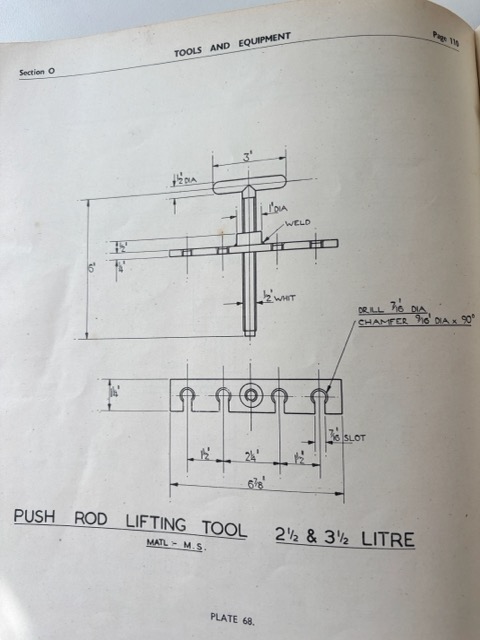
A ‘Pushrod lifting tool’. But no clues on how to use it, where to place it, how it functions…
Much head scratching followed. Obviously I dont have that tool, but the reason Jaguar kindly supply drawings like this is to enable mechanics to make one. That’s fine, I can indeed make one - but how is it used?
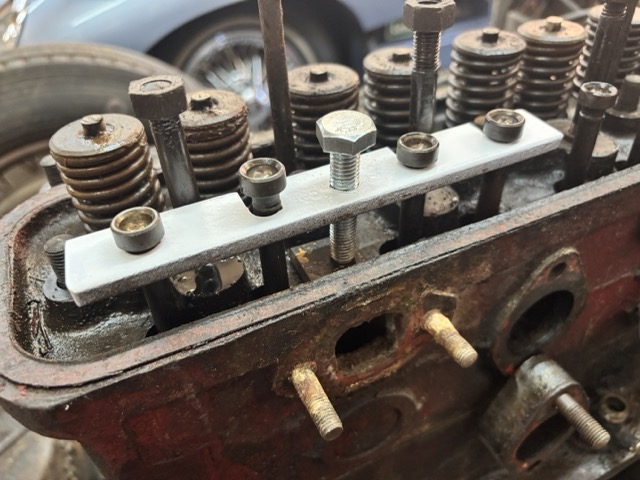
I asked the forum again but sadly no-one had any ideas, apart from one chap who said it goes under the push rods and lifts them. Thanks for that… Other people chipped in and said they never used one but they didn’t say how they got past this stage. Then one night - I awoke and had a Eureka moment - perhaps the tool went on the TOP of the cylinder head and when that central ’T’ shaped part in the drawing was rotated, the plate would raise up to the shoulder of the cup at the top of the pushrod and it would then lift all 4 of the Pushrods away from the Cam follower block. Now this was an exciting moment and I spent a happy 30 minutes in my workshop fabricating ’the tool in section O’.
Below you can see it in place and yes it does indeed lift all 4 of the push rods away from the cam follower block. 

Huzzah.... onwards