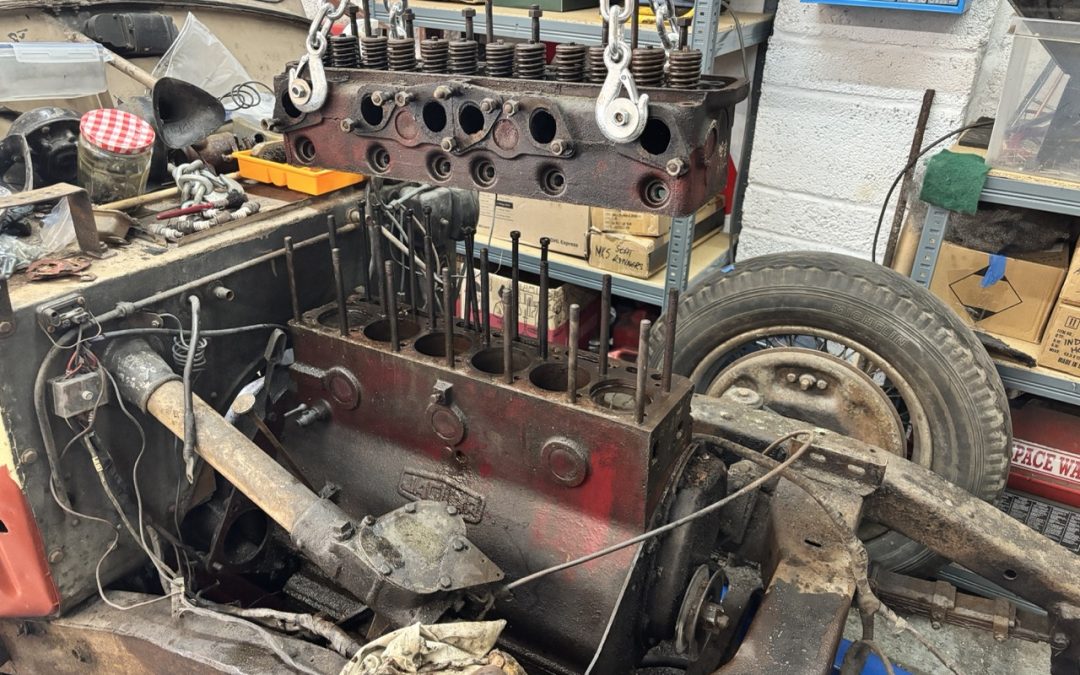
I awoke this morning with a bit of a Eureka moment concerning the removal of the head. In my waking moments it occurred to me that perhaps I might not need to remove the valve push rods because if the hole they went through had sufficient clearance then they would pass straight through when I lifted the cylinder head up. I had removed 4 of the 12 push rods because the service manual implied that I needed to remove them all - so I simply tried inserting one of the removed push rods (upside down) into the hole and I am very happy to report that they had loads of clearance so I removed the tool I had made as I clearly didnt need to continue with removing them all at this time.
It was at that moment that I noticed the front of the cylinder head had lifted up a couple of mm but the back was still firmly against the engine block so it occured to me that perhaps my engine crane was NOT lifting the head vertically. So I adjusted the handle of the engine stabiliser so that the crane now lifted the rear of the engine slightly more than the front. This lifted the head (slightly) at the rear but the front had dropped down. This was great news and was rather exciting because it meant that in theory the head WOULD lift up if I adjusted the engine stabiliser just-so.
With a little more adustment and additional lift applied to the crane hydraulic ram the head moved up evenly a couple of millimeters. Excitement was high now so I continued to raise the crane and the head slid happily up the studs and OFF the engine! I was overjoyed and I just had to share this moment of success with my ever patient wife who strangely was not quite as entusiastic as I was 🙂
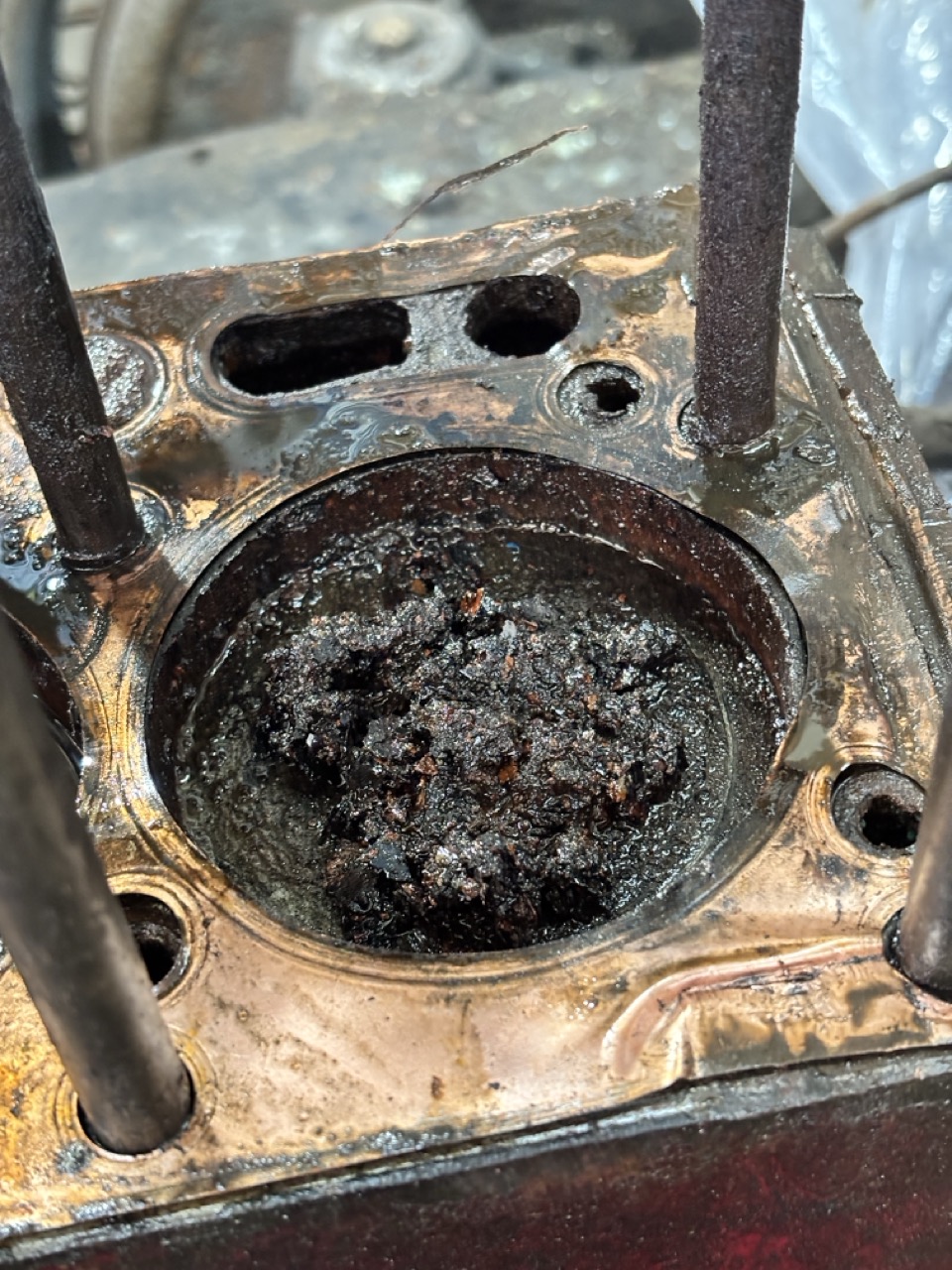
I could now take my first look inside the engine and noticed that all of the bores were still full of diesel, which I had poured into them in the hope that it would soak into the rust and free up the pistons. If it did do anything then it wasn't a total success because I would image some of the diesel would have found its way into the sump. So I removed most of the liquid so that I could take my first look at the cylinder bores. I was greeted with seeing sludge as you can see in the photo above. This was a thick sediment that wiped off the top of the piston revealing corrosion around the edge of the piston. The other cylinders were about the same - the bores are clearly pretty rusty so I will need to clean out all the rust I can see before trying to remove the pistons.


The exciting part is of course that the cylinder head is now off and I can move onto the next steps of trying to release the pistons. My thanks go to the learned people on the Jaguar Lovers Forum for suggesting the use of an engine crane to release the head.
Well done Rusty. When the pistons are clean on top I would still try acetone it’s very searching. It may free the seised pistons. I was going to suggest before the head was removed. Make an adaptor from an old spark plug with a grease nipple fitted, find a cylinder with the valves closed fill with oil. A grease gun will apply tremendous pressure.
The principle is used tension the tracks on Bulldozers.
Congrats – always great to finally see inside a rusty old engine!