Well this post is a major milestone and one that has taken 18 months to get to this position.
Today, I have mostly been working on the engine, hence the title 'going back in'. I had found an engineer who has built 96 of these engines so he knows what he is doing AND he said he could definitely remove the seized pistons which sounded great but the labour costs for the engine rebuild were not insignificant. I also spoke to a famed engineer who designed and built racing engines in the 1960's and was a big name in touring cars. We had a very lovely chat and he was willing to help and would charge much less as it is more of a hobby these days, but he is not a young man and manouvering great big lumps of cast iron around is a challenge for everyone.
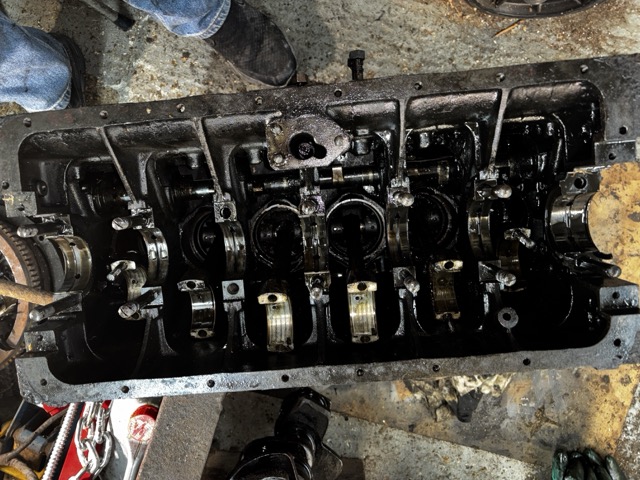
So I thought I would have 'one-more-go' at removing the oil pump, the crankshaft, the timing chains etc with a hopeful end result of being able to lift out the crankshaft and gain access to the last two bolts on the conrods that were positioned right next to the wall of the cylinder block.
Challenge one was the oil pump - a mechanical device that sucks oil from the sump pan and pushes it around the engine to lubricate the moving parts and to also to remove friction and keep things cool. Problem is that although I could undo the 3 nuts holding it in position - I could not for the life of me work out how to then remove it. Weirdly today - I undid the 3 nuts and simply lifted the pump off the studs. Job done. Why it wouldn't do that the first time is beyond me. I did strip it down to have a look at the internals and I cant see any reason why it would not be re-usable once it is cleaned up.
Next the time chain cover which sits on the front of the engine - that will link the crankshaft (which rotates the pistons) and the camshaft (which operates the valves that let in/out the petrol and exhaust fumes. Those two items are closely related to make the engine run. Getting the cover off was fine - apart from one hidden bolt which once removed allowed the cover to be pulled free. What I wasn't expecting was to hear a metallic 'ting' as a piece of flat metal fell out of the cover and onto the floor. Following a close inspection of the simple parts inside the cover I could see that the timing chain tensioner was doing - well pretty much nothing to be honest and on even closer inspection - it turned out that the 'ting' was part of the broken chain tensioner. Whilst a broken chain tensioner is not a good thing for a working engine - finding out now that it was broken is a good thing because I can replace it with something better. Below is the timing chain and slightly to the right you can see a pice of thin curved metal which is half the chain tensioner.
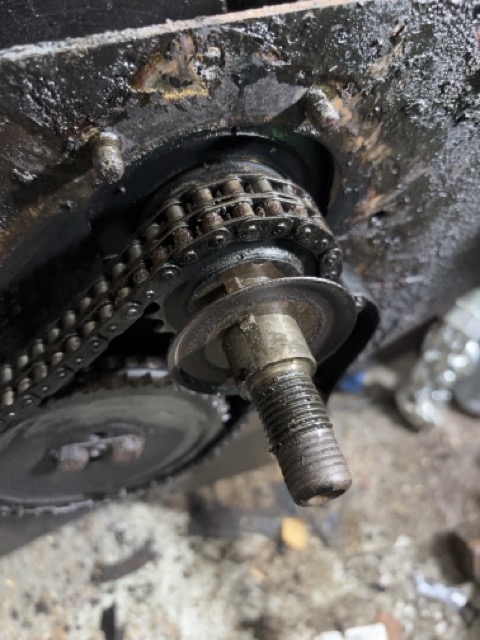
Once the chain was removed and the big pulley that connects to the camshaft - it was simple to remove the entire engine mount plate that sat behind the chains.
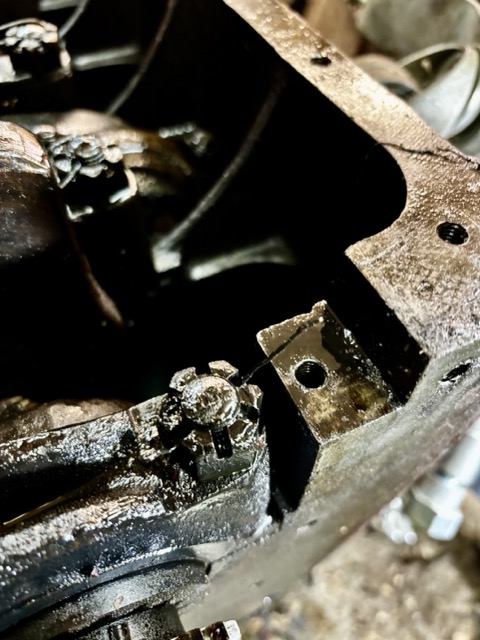
At the back of the engine I was expecting to find some kind of fancy oil seal, it might be rope based, it might be rubber... what I wasn't expecting was to find nothing more than a helical spiral in the end of the crankshaft that I can only assume was designed to redirect oil back into the sump. There was no seal at all. That may be right or it may be wrong... a question for the learned people on the pre war forums. Either way I removed the housing and a couple of simple steel blocks that bridged the crankshaft to hide a crankshaft mounting bracket. Now the Crankshaft has a number of replaceable white metal bearings that are sized to allow the crankshaft to float on a minuscule film of oil so the bolts need to be tight and prevented from coming undone. This is usually achieved by a pin that goes through the nut AND bolt when it has been tightened to the correct torque. Unfortunately someone has been inside the engine before and they tightened all the nuts to a ludicrous level that 'almost' prevented me from undoing them. But it is amazing what you can do with a spanner that is half a meter long AND an air powered hammer tool - those nuts were going to get undone one way or another, but the important thing was that there was NOT a pin going though the cult and bolts - just some thin wire! Previous owners of the car were lucky those nuts didnt simply break the wire and come undone...
Its not too easy to see in the photo below but that wire is about 1/4 of the size the pin should should have been.
Cutting a long story short - I undid all the crankshaft mounts which enabled (in theory) the crankshaft to lift out of the bottom of the engine - expect remember that it was still connected to two of the pistons. I was surprised to find that the crankshaft DIDNT just lift up swinging the two troublesome conrods into an accessible position. Eventually I had to hammer the crankshaft up and that released a few of the pistons so I continued doing this until eventually those two pistons moved enough to be able to get a spanner on the nuts and hitting said spanner with a hammer oh-so-slowly undid the nuts. NOW the crankshaft lifted up and out of the engine - Huzzah! I discovered that some of the con rods had semi seized onto the piston tops and they didnt simply swing free (like they should). So that is one piece of the puzzle why the engine was seized.
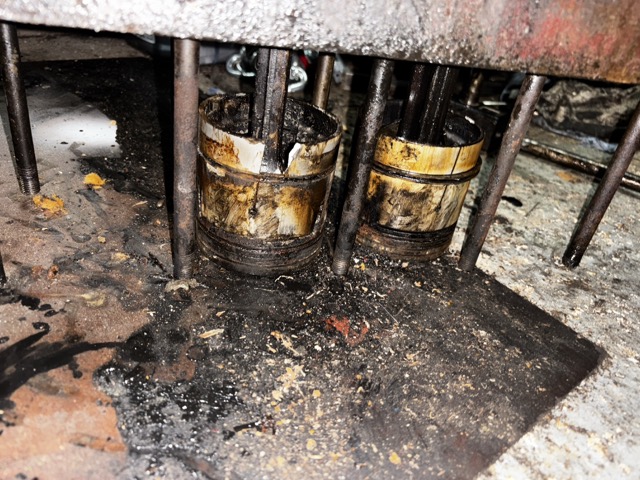
With the crankshaft removed from the engine - all the pistons were now separate mechanical items and I could 'try' to remove one piston at a time. Naturally none of them moved - they were ALL seized into the engine block. Even an air hammer did literally nothing to move any of them.
So I decided brute force was the only way - there was just about enough room to get a 12mm bar of tool steel down into the bowels of the piston with the aim of hitting that with a hammer to persuade the piston to slide out of the bore. I tried a few hammers with no joy and ended up using a 4lb club hammer which after a few VERY hard hits moved a piston slightly. Over joyed that something had actually moved my enthusiasm fueled some very physical hammer hitting and after around 40 minutes..... the first piston dropped out the bottom on the engine! There should have been fireworks, dancing girls and much champagne but all I had was some light Jazz on the radio and I moved onto the next piston, and the next, and the next...
After several hours and one hell of a lot of hard hammering - ALL SIX PISTONS ARE OUT OF THE ENGINE !!!
Looking at them - they were simply gummed up with old carbonised oil which had rusted the rings onto the bores of the cylinders - there was nothing catastrophic - but no amount of soaking in magic fluids was ever going to free them up. Brute force was the only way.
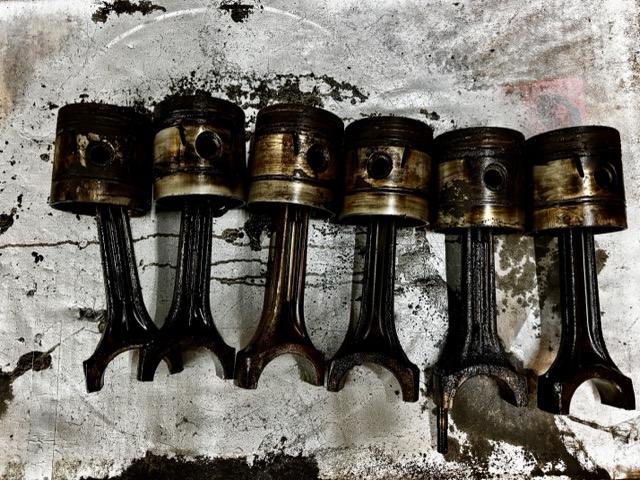
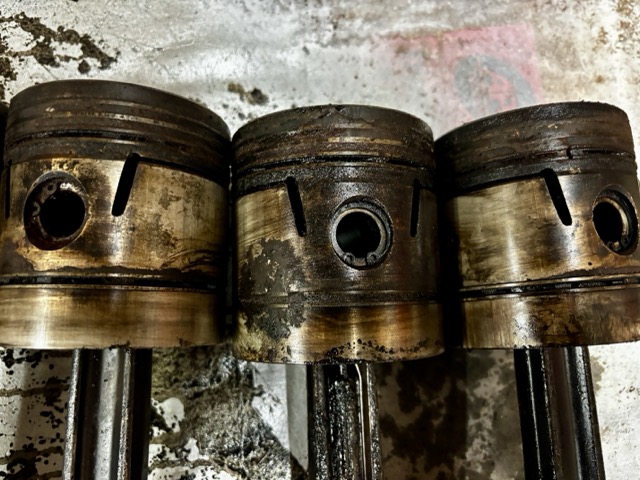
So now - it's simply a need of degreasing everything and starting to take parts to the engine shop for machining, purchasing a load of new parts and the fun part - rebuilding the engine itself. I can do that - I now know how simple the engine is, there is nothing clever to rebuilding it and that is something I can definitely do myself.
The biggest part of good news is that the car is restorable! The original engine CAN be rebuilt and one day this old MK4 Jaguar will be driven on the UK roads again. I am feeling pretty good at the moment.
Fabulous to see, I have an engine in a similar position, went through the same forced removal. And one of the pistons was damaged on removal. Rings were already broken after a similar 35 years without running. Will look forward to your updates and might copy your progress. My engine number is S87. It was removed from my mark V.
That is great news mate, I must admit to skim reading this epic episode but fantastic outcome!
Some times you just need a bigger “hammer”!🤣
Great news. Perseverance works
Well done.
Fantastic work Chris…… well worth the effort and the blog was a good read too
Fantastic result Chris! Whenever something challenging faces you, always best to leave it for a while and then go back in!