New-ish territory for me. I have removed and replaced gearbox's before but not in a Mk4 Jaguar. So I am expecting to uncover a few nuances. One of these is that the gearbox is removed through the inside of the car and out through one of the front doors. Obviously this means stripping out the interior (already done) but also removing the toe boards (the panels your feet rest on when sat in the car). These toe boards are simply flat sheets of plywood held in place with a few screws albeit the screws are rather rusty. Once removed you gain access to where the gearbox and engine are bolted together which makes life a little simpler. The clutch pedal and brake pedal are worryingly close together and I cant (yet) work out which one is incorrect - or why...
A nice feature are the rubber covers on both pedals - having a brake pedal labelled "holdtite" is either an ironic name or a simple instruction because the brakes are poor. I have a funny feeling it may be both.
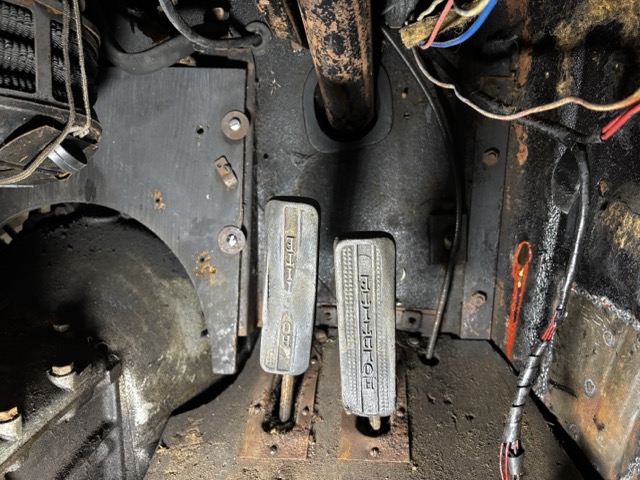
Yes the pedal rubbers are upside down - but that was probably due to uneven wear. I have reached out to learned friends in the Jaguar forums to see if these rubber pads are original fitment by Jaguar or simply a period fitting - but I am also wondering whether I can 3D print some new ones using the new TPU filament which apparently has great rubber-like qualities. Something for a rainy day..
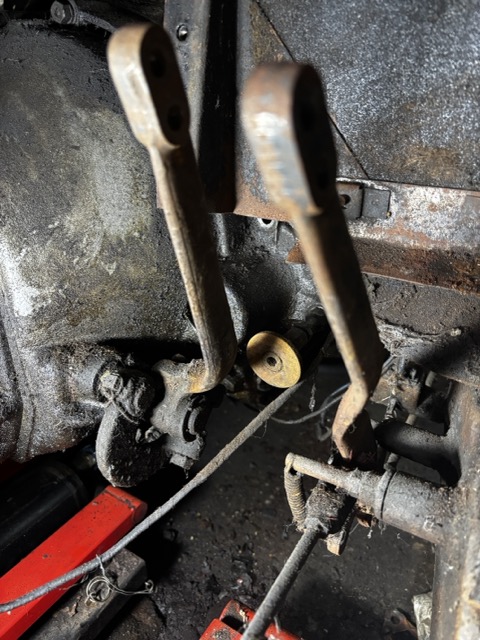
Having removed the wooden toe boards I now have access to what the pedals bolt to (see image below). The clutch pedal seems to bolt directly onto the gearbox which answers a question I had in my head as to whether or not the clutch was hydraulically operated or not - the answer is clearly 'not'. I sense driving these cars was a bit of a physical workout. I will need to take a bunch of details photos of how that is fitted before I remove anything.
The brake pedal does appear to lean to the left a little and that may be due to wear in the shaft it is bolted to - we shall see. What I DONT recognise is that round disk at the bottom of the clutch pedal. The disk has a thick rod behind it which is solidly bolted to the engine block. Maybe this is a safety stop for the clutch pedal perhaps? I have asked the forum. I am sure a clever chap is out there somewhere.
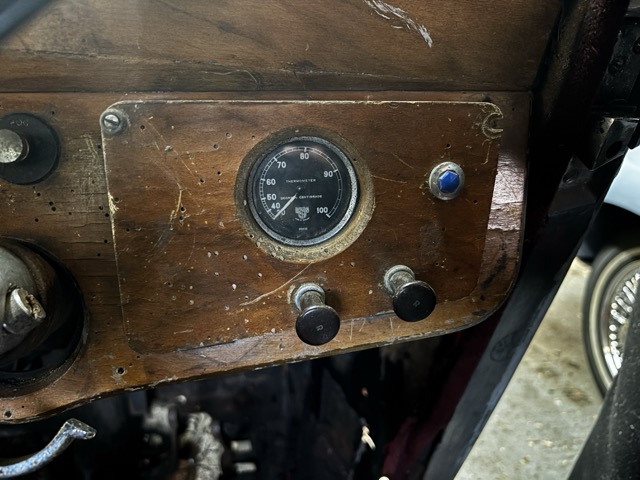
Another surprise was seeing a temperature gauge fitted to the gearbox. I have never seen that before and I know it was not an original accessory because of where the gauge is fitted (into the drivers glovebox lid-top photo). I do know the car was rallied in its early life so perhaps this was a rally thing? I wont be keeping it because I have something else I want to fit inside that glovebox but it's too early to mention that yet.
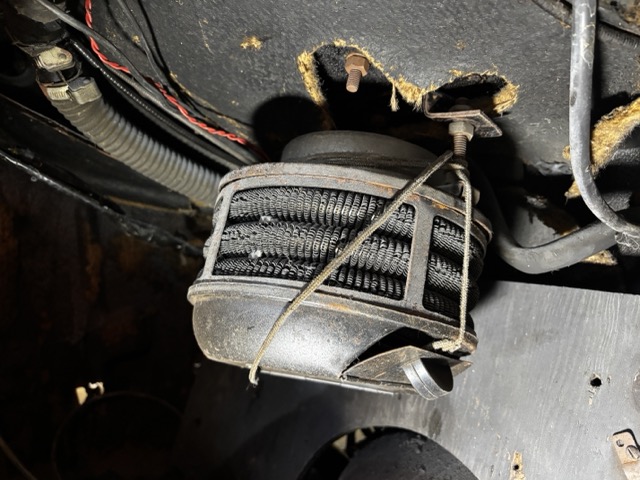
Whilst I was under the dashboard so to speak - I saw that the heater or 'air-conditioning' as they called it in the 1940's is held together with some string which I rather suspect is not correct. I wonder why that was done and what now needs fixing. It is a rather strange looking thing but I was lucky enough to find the interior trim that fits around it - so its nice to know that one day - we will at least have warm feet.
Well done with the head removal
Major progress, now you can get at the pistons and bores
Good Luck
Impressed with your tenacity.